
RYA logbook: which one you need and how to fill it in
Which book is which (G73, G158, G109), what to write in each entry, who signs it, and whether a PDF, spreadsheet or app will do for the Yachtmaster exams.
An RYA logbook is the book you record your sea time and course progress in. For the Yachtmaster scheme, two RYA books matter. The RYA Personal Logbook (G73) is a record of your passages across a number of boats, with pre-exam information for the Yachtmaster certificates. The RYA Yachtmaster Scheme Syllabus and Logbook (G158) is the course syllabus, with pages to log your progress and keep your certificates.
The RYA doesn’t insist on a particular book. You must log your qualifying sea time and present it “in a suitable format”, then show your logbook to the examiner at the exam.
The RYA logbooks compared
For yacht cruising, the G73 records your own sea time, the G158 is the syllabus and your course record, and the G109 is a log for the boat.
| Code | Title | What it is for | Who it suits | Format | RYA shop price (17 October 2026) |
|---|---|---|---|---|---|
| G73 | RYA Personal Logbook | Your record of passages across many boats, with season summaries | Cruising sailors logging sea time | Hardback | £18.99 |
| G158 | RYA Yachtmaster Scheme Syllabus and Logbook | Cruising course syllabus, progress pages and space for certificates | Sail and motor cruising students, up to Yachtmaster Ocean | Paperback | £8.49 |
| G109 | RYA Sail & Power Logbook | A passage log for the boat, plus engine log and other boat records | Cruising boaters keeping the boat’s own log | Hardback | £18.99 |
| G4 | RYA National Sailing Scheme Syllabus and Logbook | Dinghies, keelboats and multihulls | Small-boat sailors | Paperback | £8.99 |
| G20 | RYA Powerboat Scheme Syllabus and Logbook | Powerboat courses | Powerboat students | Paperback | £8.99 |
Prices as shown on the RYA shop on 17 October 2026, when delivery was £2.
RYA Personal Logbook (G73): your sea time record
The G73 is designed for sailors on several boats. Most of its 128 pages are cruise log pages, followed by a season summary and a summary of vessels sailed.
The RYA describes its pre-exam information as covering the Coastal Skipper certificate of competence, the exam now called Yachtmaster Coastal. The book is the 2010 edition (reprinted 2025), so check current requirements on rya.org.uk.
Yachtmaster Scheme Syllabus and Logbook (G158): the syllabus and your course record
The G158 sets out the practical and shorebased courses for sail and motor cruising, with pages to log your progress and keep certificates. It is a different book from a personal logbook. The G158 records your courses and the G73 records your passages.
The RYA points Yachtmaster Coastal candidates to the G158 for the full exam syllabus and asks them to have read it before booking. It replaced the older G15 and G18 books.
Sail & Power Logbook (G109): a log for the boat
The G109 log pages include columns for time, course, log, wind, barometer, engine and remarks, and further pages hold an engine log and an equipment list. The RYA sells it alongside the G73, so neither replaces the other.
G4 and G20: the dinghy and powerboat schemes
The G4 is the National Sailing Scheme book for dinghies, keelboats and multihulls, and the G20 covers the Powerboat Scheme.
Which logbook you need at each stage
You don’t need a logbook to book Competent Crew. Day Skipper Practical is the first course that asks for sea time before you start, and at the Yachtmaster exams you show your logbook to the examiner.
| Stage | Sea time asked for before you start? | Book to have |
|---|---|---|
| Competent Crew practical | No: no previous experience required, and you’re assessed on how you perform on board | G158 for the syllabus; a G73 if you want these days on record (our advice) |
| Day Skipper Practical (sail) | Yes: 5 days, 100 miles and 4 night hours aboard a sailing yacht, plus navigation and theory knowledge to Day Skipper shorebased level | G73 and G158 |
| Coastal Skipper Practical (sail) | Yes: 15 days, 2 days as skipper, 300 miles and 8 night hours | G73 and G158 |
| Yachtmaster Coastal and Offshore exams | Yes: documented sea time from the last 10 years, logbook shown to the examiner | A G73 or another suitable format, plus the G158 |
The Yachtmaster figures are on our page of RYA sea time requirements for each qualification.
Our advice, not an RYA rule: start a G73 from your first passage. Exam sea time counts back 10 years, and a record is hard to rebuild from memory.
Your personal logbook and the boat’s log are different things
A sailing logbook is a written record of passages, and there are two kinds. A personal logbook such as the G73 records your own sea time and follows you from boat to boat. A boat’s log, laid out like the G109, belongs to the boat: it records that boat’s passages, and the G109 adds pages for its engine log and equipment list.
Do boats have to keep one? A private leisure yacht doesn’t. UK law requires UK-flagged ships to carry an official log book, but ships under 25 gross tons and private pleasure yachts are exempt. The MCA’s SOLAS V leaflet for pleasure craft covers passage planning and doesn’t mention a logbook.
The leaflet does advise having the skills and information to reach safety without GPS, and in our view a log of regular positions helps with that.
The boat’s log matters at Yachtmaster Ocean, where the examiner asks for copies of the vessel’s log pages from the qualifying passage.
How to fill in a sailing logbook entry
Each entry should record when and where you sailed, the boat, the distance and your role. Add the days, night hours and tidal or non-tidal water that the exam form asks for. The RYA lists three things the G73 has space for: the distance of each passage, the maximum wind strength and the capacity you sailed in. It doesn’t publish the other headings, so the template below follows what the exams need, not the layout of the printed page.
An example entry, as a template
| Field | What to write | Why it matters |
|---|---|---|
| Date(s) | [start date] to [end date] | Counts only within 10 years of the exam |
| Boat | [name], [sail or power], [length overall] | Must match the exam’s vessel type; over 24m counts differently |
| From / to | [departure port or safe haven] to [destination port or safe haven] | A passage is non-stop between the two |
| Distance | Planned [x] miles, run [y] miles | Both should exceed a minimum-distance requirement |
| Maximum wind | [Beaufort force] | The G73 has space for it |
| Role | [skipper / mate / crew] | The G73 records capacity; the RYA defines skipper and mate |
| Days on board | [n] | Eight consecutive hours living aboard, mostly at sea |
| Night hours | [n] | The exam form asks for them |
| Tidal or non-tidal | [tidal / non-tidal] | At least half should be tidal |
| Skipper’s name | [name] | Our suggestion, not an RYA rule |
| Notes | [weather, incidents, your watches] | Examiners question candidates extensively about their passages |
Recording your role: skipper, mate or crew
The skipper is the person nominated and responsible for planning and executing the passage, not necessarily the most experienced aboard. If the role changes hands during a passage, neither person can claim it. A mate has sole responsibility for a navigational watch.
Counting days, night hours and tidal water
A day on board is eight consecutive hours living aboard, most of it at sea. Shorter periods can’t be added together, and only one counts in any 24 hours. Water is tidal where published stream, current or tidal range data is significant enough that you have to allow for it.
The exam form asks for days, miles and night hours, each split into tidal and non-tidal. The G73’s season summary pages give you at-a-glance mileage totals. If you split your season totals the same way, the form takes less work. There’s more on how the RYA counts days, miles and night hours.
Logging the longer passages for Yachtmaster Offshore
Yachtmaster Offshore asks for 5 passages over 60 miles, including 2 overnight and 2 as skipper. A passage is non-stop between ports or safe havens, so a day with a stop in the middle is two passages. Both the planned distance and the distance run should exceed 60 miles, and artificially lengthened passages aren’t accepted.
What the examiner checks, and who signs
The examiner checks your logbook and your eligibility at the exam, and you sign a declaration on the application form. The declaration says the information is correct and that you’re eligible.
You don’t send the logbook with the form. The form states: “Only original documents will be accepted.” If you’re claiming reduced sea time with a course completion certificate, show that too.
We found no RYA page requiring a skipper to countersign each entry. Advice on the YBW sailing forum is to get the skipper’s signature for each bit of experience anyway; ask your training centre what they expect.
Is there an RYA logbook PDF, template or app?
We found no official free RYA logbook PDF. The RYA names no single book: it asks for sea time “logged and presented in a suitable format”.
Is there a free RYA logbook PDF?
No logbook is among the RYA’s eBooks, and we couldn’t find the G73 or the G158 offered as a free official download. The top search result we found for “rya logbook pdf” was a generic e-signature form site.
Templates and spreadsheets
Yachting Monthly suggested in 2016 a cheap hard-backed exercise book ruled with your own columns. A spreadsheet also works, as long as it meets the RYA’s “suitable format” test. Use the template fields above so you can total tidal and non-tidal sea time for the exam form.
Logbook apps
The Nautis logbook and its G73-format export is one option: a free sailing logbook app for iOS and Android, still in testing. From each trip’s GPS track it works out distance and night hours, and suggests a count of days on board that you can correct.
Each trip exports as a Voyage Record in RYA Personal Logbook (G73) format, as PDF or CSV, asking for crew role, tidal or non-tidal water and the skipper’s name. The PDF ends with a line for the skipper’s signature, signed on paper.
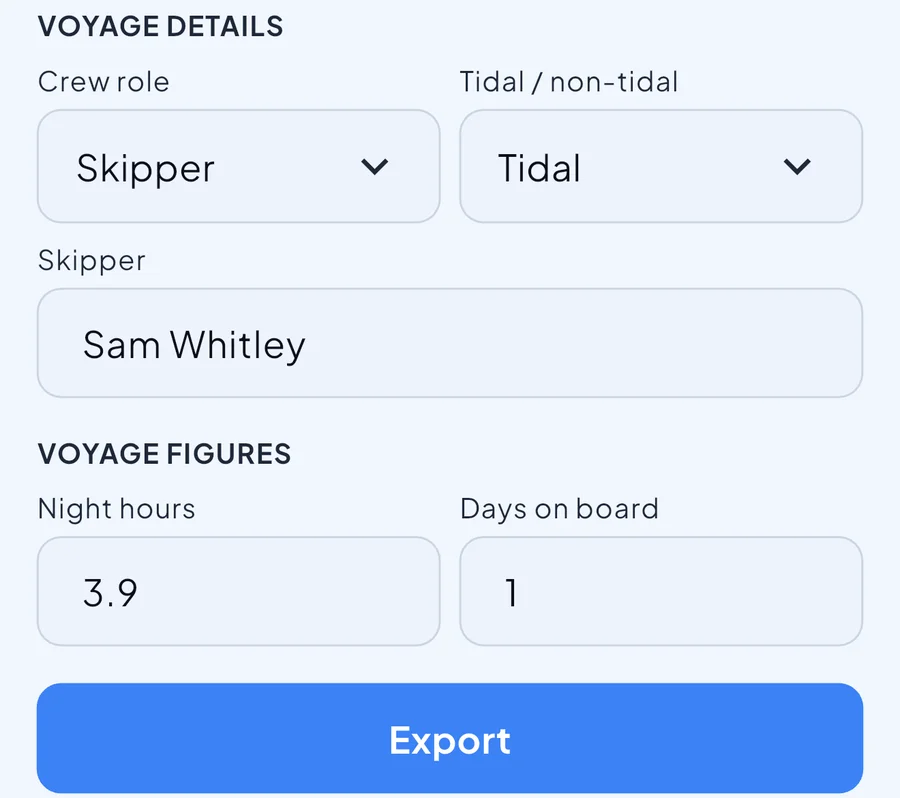
Before export, Nautis asks for your crew role, tidal or non-tidal water and the skipper’s name. Nautis app screenshot
Earlier passages can’t be added, so that sea time stays in your paper logbook. There’s more on why Nautis was built.
Where to buy an RYA logbook
You can buy an RYA logbook from the RYA shop, which sells all five books at the prices in the table above. Other retailers sell them too, and prices vary: on 17 October 2026 Imray listed the G73 at £14.99, against £18.99 on the RYA shop. Avoid second-hand copies of the G15 or G18, as the G158 replaced both.
Questions
Do I send my logbook to the RYA with my exam application?
No. You show it to the examiner at the exam instead. The RYA says that in most cases you should apply through its online exam and application payments service, which produces a pre-populated form.
What are the requirements for a Yachtmaster logbook?
The RYA names no required book. Your qualifying sea time must be logged in a suitable format and shown to the examiner. It must fall within 10 years of the exam, be on the right type of vessel, and be at least half in tidal waters.
How far back does logged sea time count?
For Yachtmaster Coastal and Offshore, the minimum sea time and qualifying passages must fall within 10 years of the exam date.
Does sea time on a motor boat count towards a sail exam?
No. Qualifying sea time must be gained on sailing vessels for a sail exam and power vessels for a power exam, so note the boat type in every entry.
Is the RYA logbook G4 for yachts?
No. The G4 is for dinghies, keelboats and multihulls in the National Sailing Scheme. Yacht cruising sailors want the G158 and a personal logbook such as the G73.
Do I need a separate logbook for each boat I sail on?
Not for your own sea time: the G73 is designed for sailing on several boats and has a summary of vessels sailed. A boat's own log stays with the boat.
What does the Yachtmaster Ocean exam need from my log?
Copies of the vessel's log pages for the qualifying passage and a narrative account of planning and sailing it, sent to the examiner 48 hours before the exam.
Sources
- RYA Personal logbook | Products (RYA shop)
- RYA Yachtmaster Scheme Syllabus and Logbook | Products (RYA shop)
- RYA Sail & Power Logbook | Products (RYA shop)
- RYA National Sailing Scheme Syllabus and Logbook (RYA shop)
- RYA Powerboat Scheme Syllabus and Logbook (RYA shop)
- RYA Yachtmaster Coastal Exam
- RYA Yachtmaster Offshore Exam
- RYA Yachtmaster Ocean Exam
- Qualifying Passages: Requirements for RYA exams
- RYA/MCA Practical Exam Application Form (Advanced Powerboat, Yachtmaster Coastal, Yachtmaster Offshore), linked from rya.org.uk Arranging your exam
- Arranging your exam (RYA)
- RYA Competent Crew Practical Course
- RYA Day Skipper Practical (sail)
- RYA Coastal Skipper Practical (sail)
- eBook and audiobook information (RYA shop)
- Official Log Books, UK Ship Register (Maritime and Coastguard Agency, Crown Copyright)
- SOLAS V for Pleasure Craft, MCA/098, July 2014 (gov.uk)
- RYA Personal Log Book G73, Imray store
- Skipper's tips: cheap and cheerful, Yachting Monthly, 6 May 2016