
RYA sea time requirements: what counts and how to log it
Yachtmaster Coastal needs 30 days, 800 miles and 12 night hours; Offshore needs 50 days and 2,500 miles. Every RYA level in one table, what counts, and how to log it.
The RYA sea time requirements for Yachtmaster Coastal are 30 days at sea, 2 days as skipper, 800 miles and 12 night hours. A Coastal Skipper Practical course completion certificate brings that down to 12 days and 400 miles. Yachtmaster Offshore needs 50 days at sea, 5 days as skipper, 2,500 miles and 5 passages over 60 miles, including 2 overnight and 2 as skipper. For both exams the sea time must be documented, gained in the last 10 years and at least half in tidal waters.
The sailing courses ask for less. Day Skipper Practical lists 5 days, 100 miles and 4 night hours, and Coastal Skipper Practical lists 15 days, 2 as skipper, 300 miles and 8 night hours. The figures for every level are set out below, followed by the RYA’s definitions, the certificates you need and how to log your sea time.
RYA sea time requirements at each level
RYA sea time requirements range from none for Competent Crew to 50 days and 2,500 miles for Yachtmaster Offshore. The course figures are entry experience; the Yachtmaster figures are exam prerequisites.
| Level | Days at sea | Days as skipper | Miles | Night hours | Passages | What it is |
|---|---|---|---|---|---|---|
| Competent Crew Practical | None | None | None | None | None | Course: no experience required |
| Day Skipper Theory | Some practical experience desirable | Not listed | Not listed | Not listed | Not listed | Course |
| Day Skipper Practical (sail) | 5 | Not listed | 100 | 4 | Not listed | Course: required experience |
| Coastal Skipper Practical (sail) | 15 | 2 | 300 | 8 | Not listed | Course: required experience |
| Yachtmaster Coastal | 30 | 2 | 800 | 12 | Not listed | Exam prerequisite |
| Yachtmaster Coastal, with Coastal Skipper Practical certificate | 12 | 2 | 400 | 12 | Not listed | Exam prerequisite |
| Yachtmaster Offshore | 50 | 5 | 2,500 | Not listed | 5 over 60 miles, incl. 2 overnight and 2 as skipper | Exam prerequisite |
| Yachtmaster Offshore, already Offshore in the other discipline | 25 | 3 | 1,250 | Not listed | 3 over 60 miles, incl. 1 overnight and 1 as skipper | Exam prerequisite |
Figures come from the RYA course and exam pages. Several Yachtmaster figures are stated for vessels under 24m LOA, and time on larger yachts counts only in part (see the boat size table below).
Course experience and exam prerequisites are different things
The RYA course pages label the Day Skipper Practical and Coastal Skipper Practical figures “Required experience”. The Coastal Skipper page also expects boat handling to Day Skipper Practical standard. The Yachtmaster figures are exam prerequisites. Before booking, the RYA asks you to check you have the required mileage and skipper experience, an SRC and a valid first aid certificate.
Coastal Skipper Practical is a course; Yachtmaster Coastal is an exam and certificate of competence.
The Coastal Skipper Practical reduction: 12 days, not 20
A Coastal Skipper Practical course completion certificate cuts Yachtmaster Coastal to 12 days and 400 miles on vessels under 24m LOA. A Yachtmaster Coastal certificate in another discipline does the same. The 2 skipper days and 12 night hours are not reduced. Bring the certificate to the exam: the examiner must see it if you claim the reduction.
Wikipedia and some training sites still give 20 days. That was the RYA’s own wording in 2017 and March 2020; by June 2021 its page said 12 days.
Offshore reductions are only for existing Offshore holders
The reduced Offshore figures (25 days, 3 as skipper, 1,250 miles, 3 passages) apply only if you already hold Yachtmaster Offshore in another discipline. A Sail holder taking the Power exam is one example. A Coastal Skipper Practical certificate does not reduce them.
What counts as a day at sea and a day as skipper
For the RYA, a day at sea or a day as skipper is eight consecutive hours living on board, most of them with the vessel at sea.
A day at sea
The RYA’s wording is “a period of eight consecutive hours living on board, the majority of which the vessel should have been at sea”. Shorter periods cannot be added together, and only one eight-hour period counts in any 24 hours. Two four-hour day sails count for nothing; a 48-hour passage counts as two days.
A day as skipper
The same eight-hour test applies. The skipper is the person nominated and responsible for planning and executing the passage, including vessel and watch management. They need not be the most experienced person on board.
If the role is transferred during a passage, neither person can claim to have skippered it. Agree who is skipper before you leave and write it in the log.
Qualifying passages for Yachtmaster Offshore
Yachtmaster Offshore needs 5 qualifying passages over 60 miles, including 2 overnight and 2 as skipper. A passage is a continuously underway, non-stop voyage from one port or safe haven to another.
Distance is judged on the shortest navigable route, and artificially lengthened passages are not accepted. Both the planned distance and the distance run should exceed 60 miles. Skipper and mates should not change during the passage. A mate is anyone with sole responsibility for a navigational watch.
The RYA strongly advises completing the Coastal Skipper Practical course before skippering 60-mile passages, unless you have substantial experience in charge.
Night hours: what the RYA does and doesn’t define
You need 4 night hours for Day Skipper Practical, 8 for Coastal Skipper Practical and 12 for Yachtmaster Coastal, which has no reduction. The Offshore list has no night-hours figure; it asks for 2 overnight passages instead.
The RYA’s exam pages and its qualifying passages page do not define a night hour or say whether time asleep off watch counts. Read the guidance in your logbook and ask your training centre. The G73 includes some pre-exam requirements, and the RYA points to the G158 for full exam requirements.
Log night hours as they happen. The application form asks for them split by tidal and non-tidal water, and examiners question candidates on their sea time.
Tidal waters and the half rule
At least half the qualifying sea time for Yachtmaster Coastal and Offshore should be gained in tidal waters. The application form puts it the other way: no more than 50% may be in non-tidal seas such as the Baltic or Mediterranean.
The RYA deems an area tidal if published stream, current or tidal range data is available and its influence is significant enough that it must be taken into account to plan and execute the passage. Streams and currents count as well as rise and fall.
Training providers commonly treat the Mediterranean, Baltic, Caribbean, Black Sea and Caspian as non-tidal. Mark each log entry tidal or non-tidal, because the form totals them separately.
The 10-year window, boat size and sail or power
Yachtmaster sea time must be from the last 10 years, on a suitably sized vessel, in the same discipline as the exam.
Sea time must be from the last 10 years
Minimum sea time and qualifying passages must be gained within 10 years of the exam date. A 2015 passage will not count towards a 2026 exam.
Boat size limits
| Vessel | Counts towards Coastal and Offshore |
|---|---|
| Between 7m LWL and 24m LOA | Full credit |
| Over 24m, up to 3000gt | Days at sea and miles only: up to 50% of the minimum, with a testimonial or seaman’s discharge book. Not listed for days as skipper or Offshore qualifying passages |
| Over 24m and over 500gt | Contact [email protected] |
Sail time for a sail exam, power time for a power exam
All qualifying sea time and passages must be on sailing vessels for a sail exam and power vessels for a power exam.
Certificates you need alongside the sea time
Both Yachtmaster exams need a GMDSS-compliant marine radio certificate, such as the RYA SRC, and a valid first aid certificate.
| Requirement | Yachtmaster Coastal | Yachtmaster Offshore |
|---|---|---|
| Marine radio | GMDSS-compliant, such as the RYA SRC or higher | Same |
| First aid | RYA First Aid or an alternative meeting RYA minimums | Same |
| Coastal Skipper Practical certificate | Only if claiming reduced sea time | Not required |
| Minimum age | 17 | 18 |
An alternative first aid course must be at least 1 day with 6 hours of instruction. Certificates should be renewed every three years, or up to every 5 for STCW first aid. UK-registered practising doctors, nurses, paramedics, physician associates and dentists can use their registration instead.
How your sea time is checked
The examiner checks your sea time at the exam, against your logbook and the eligibility declaration you sign. You are responsible for logging your sea time and presenting it in a suitable format.
The application form asks for days, miles and night hours, each split into tidal and non-tidal. Don’t send the logbook with the application; show it to the examiner at the exam. Only original documents are accepted. Expect extensive questions on your passages, mileage and sea time.
Most exams are arranged through an RYA Recognised Training Centre. If you request an examiner through the RYA, allow at least 10 working days.
How to log sea time so it holds up
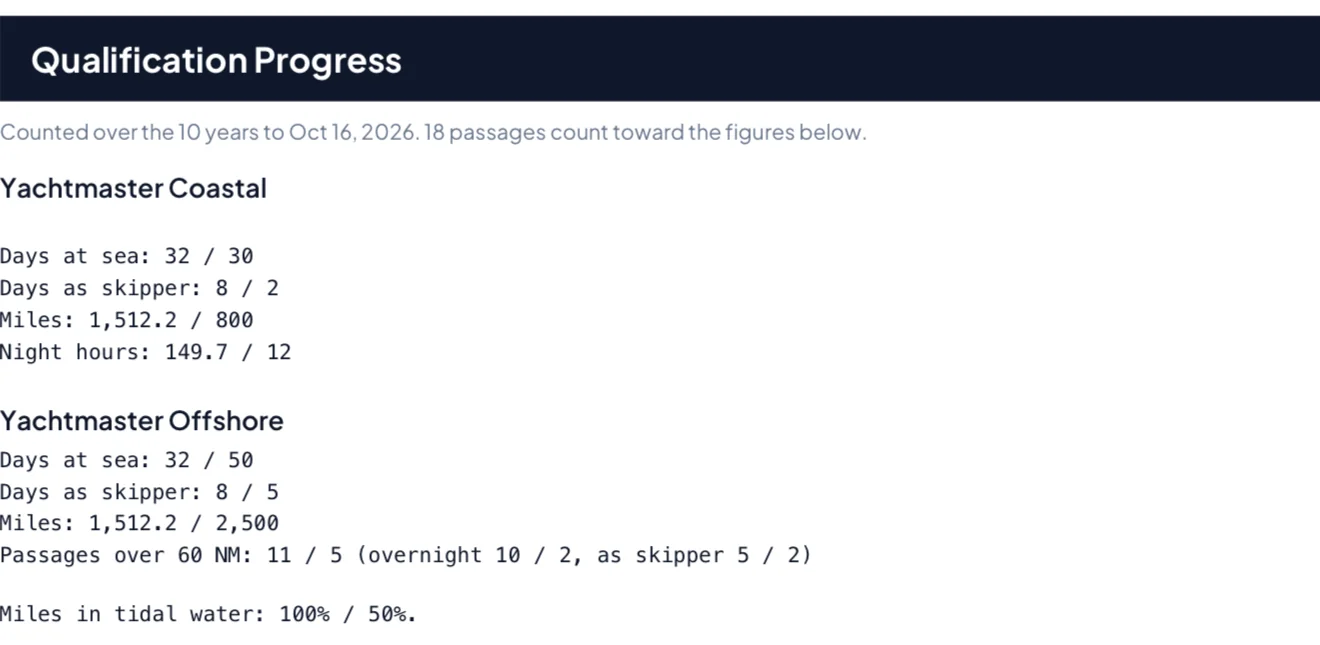
The qualification tally in a Nautis Career Personal Logbook export, shown with sample data. It counts against the RYA’s unreduced Yachtmaster figures, so it does not apply the Coastal Skipper Practical reduction. Nautis is in testing. Nautis app screenshot
Log each passage with the details the RYA tests turn on: hours on board, your role, distance, night hours and tidal or non-tidal water.
What each entry should record
The RYA Personal Logbook (G73) has space for distance, maximum wind strength and the capacity in which the voyage was sailed. To show the RYA tests are met, record:
- Date and hours living on board, so each eight-hour day can be shown
- Vessel name and length
- Departure and arrival ports
- Your role: crew, mate or skipper
- Distance run and maximum wind strength
- Night hours
- Tidal or non-tidal water
Who signs the logbook
The Coastal and Offshore application form has no field for a skipper’s signature; the only signatures are your declaration and the examiner’s verification. Training providers still advise getting the skipper’s signature on each entry as third-party confirmation. Time on yachts over 24m needs a testimonial or discharge book.
Totting up a season
The G73 has season summary pages (pp.104–105) and a summary of vessels sailed (pp.106–113). At the end of each season, total days, miles, night hours and skipper days, keeping tidal and non-tidal separate as the form does. When you total for an exam, leave out anything older than 10 years.
G73 or G158
The G73 holds cruise log pages, season summaries and some pre-exam requirements. The G158 Yachtmaster Scheme Syllabus and Logbook has pages to log progress and keep certificates. It was reprinted in 2025 and clarifies pre-exam requirements for all Yachtmaster exams. The RYA exam pages point to the G158 for full requirements.
Logging with an app
Nautis, the app behind this site, is a free sailing logbook app for iOS and Android, built for sailors working towards RYA qualifications. It is still in testing. Read what Nautis is and why it was built.
It records the GPS track automatically and works offline. From each trip it works out distance, night hours (from the track and the hours of daylight) and days on board. That figure is the app’s own calculation, because the RYA pages don’t define a night hour.
Each trip exports as a Voyage Record in RYA Personal Logbook (G73) format, as PDF or CSV. The export asks for your crew role, tidal or non-tidal water and the skipper’s name.
A career export adds season summaries, totals and a Yachtmaster Coastal and Offshore tally. The tally uses the RYA’s unreduced figures, since the reductions depend on certificates the app doesn’t know about. See the Nautis logbook, G73 export and Yachtmaster tally.
Questions
How long does it take to get a Yachtmaster?
It depends how fast you build the sea time. The RYA describes fast track programmes of 14–18 weeks that help reach the 2,500 miles needed for Yachtmaster Offshore, and adds that there is no substitute for experience. There is no formal course before the Offshore exam, though most candidates find a prep week useful.
Do you need sea time before the Day Skipper course?
Not for Day Skipper Theory, where the RYA says some practical experience is desirable. The Day Skipper Practical (sail) course lists required experience of basic sailing ability, 5 days, 100 miles and 4 night hours on a sailing yacht. It also expects theory knowledge to Day Skipper Shorebased level. Competent Crew needs no experience.
How far offshore can an RYA Day Skipper go?
The RYA's Day Skipper Practical page gives no distance limit. It says a Day Skipper Practical graduate can take charge of a 30–45ft sailing yacht and its crew on day trips in familiar waters. Yachtmaster Offshore covers passages up to 150 miles from harbour, by day or night.
Do I need the Coastal Skipper/Yachtmaster Offshore theory course before the exam?
The theory course page calls it a prerequisite for a Yachtmaster qualification, but the exam pages don't list it among the exam prerequisites. Check with your training centre when you book.
How old do you need to be for the Yachtmaster exams?
17 at the time of the exam for Yachtmaster Coastal, 18 for Yachtmaster Offshore.
What size of boat is used for the Yachtmaster exam?
Between 7m and 18m LOA and seaworthy, according to the exam pages; the application form notes put the lower limit at 7m LWL. Offshore needs two crew besides the candidate. Allow 6–10 hours for one Coastal candidate and 8–12 hours for one Offshore candidate.
Sources
- RYA Yachtmaster Coastal Exam
- RYA Yachtmaster Offshore Exam
- Qualifying passages | RYA Certificates of Competence
- RYA Coastal Skipper Practical Sailing Course | Course Finder
- RYA Day Skipper Practical Sailing course
- RYA Competent Crew Practical Course
- RYA Day Skipper Theory Course
- RYA Coastal Skipper/Yachtmaster Offshore Theory Course
- Which first aid certificate do I need? (RYA)
- RYA/MCA Practical Exam Application Form and notes (Advanced Powerboat, Yachtmaster Coastal, Yachtmaster Offshore), PDF linked from rya.org.uk Arranging your exam
- Arranging your exam (RYA)
- RYA Personal logbook (G73) | Products
- RYA Yachtmaster Scheme Syllabus and Logbook (G158) | Products
- Yachtmaster Fast Track: 10 tips to get the most from a Fast Track course (RYA)
- RYA Yachtmaster Coastal exam page, archived 23 Jan 2017 (Wayback Machine)
- RYA Yachtmaster Coastal exam page, archived 25 Jun 2021 (Wayback Machine)
- Yachtmaster - Wikipedia
- How Much Mileage Do You Need for Yachtmaster Coastal & Offshore?
- Qualifying Sea Time for would be Career Sailors - Classic Sailing
- RYA Logbooks: What Every Sailor Needs to Know
- What is Considered Tidal Water for a Yachtmaster Qualification?